Definition of In-App Communication
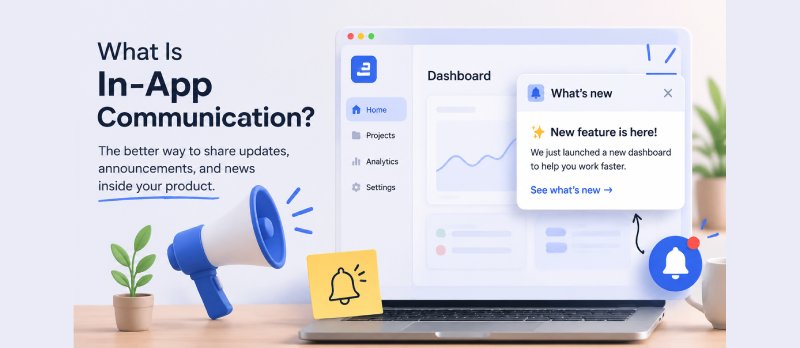
In-app communication is the practice of delivering messages, announcements, and guidance directly inside a digital product or website while a user is actively using it.
It is commonly used by SaaS products to communicate updates, onboard users, and increase product engagement without relying on external channels like email.
Why In-App Communication Exists
In-app communication exists because most users do not consistently read email updates or external announcements.
Instead, product teams need a way to:
- reach users at the moment of product usage
- improve feature discovery
- increase retention and reduce churn
- communicate product changes in real time
This makes in-app communication a core part of modern product communication strategy in SaaS companies.
Types of In-App Communication
In-app communication typically includes the following formats:
1. Product announcements
Messages that inform users about new features, updates, or improvements.
2. Changelogs
A structured list of product updates over time.
3. In-app banners
Persistent or temporary messages shown inside the interface.
4. Tooltips and onboarding guidance
Contextual messages that guide users through features.
5. Feature highlights
Prompts that draw attention to specific functionalities.
In-App Communication vs Email Communication
In-app communication happens inside the product while the user is using it. Email communication happens outside the product in the user’s inbox.
In-app communication is contextual and real-time. Email communication is delayed and can feel interruptive.
In-app communication is always visible during product usage. Email communication depends on whether the user opens the email.
In-app communication is better for feature adoption and onboarding. Email communication is better for updates and marketing messages.
In-app communication is generally more effective for product adoption and user engagement because it appears while users are actively using the product.
Why In-App Communication Improves SaaS Retention
SaaS products often lose users not because of poor features, but because users fail to notice improvements.
In-app communication helps solve this by:
- making updates visible inside the product
- reinforcing product value continuously
- increasing awareness of underused features
- reducing user confusion after updates
This directly contributes to improved user retention and activation rates.
Tools for In-App Communication
In-app communication is usually implemented using third-party tools rather than custom development.
These tools allow SaaS companies to:
- publish announcements without code changes
- manage changelogs centrally
- segment users for targeted messages
- track engagement with updates
Examples of in-app communication tools include platforms like Beamer, Headway, and AnnounceKit.
A newer example is Bellotify, a SaaS tool that enables in-app announcements and changelogs through a website widget designed for product communication inside web applications.
In-App Communication Use Cases
In-app communication is commonly used for:
- SaaS product updates
- onboarding new users
- announcing pricing changes
- promoting underused features
- improving feature discovery
Key Takeaways
- In-app communication delivers messages inside a product while users are active.
- It is more effective than email for product updates and feature adoption.
- It plays a major role in SaaS retention and user engagement.
- Tools like Bellotify simplify implementation for SaaS teams.